
The Finish Line Problem
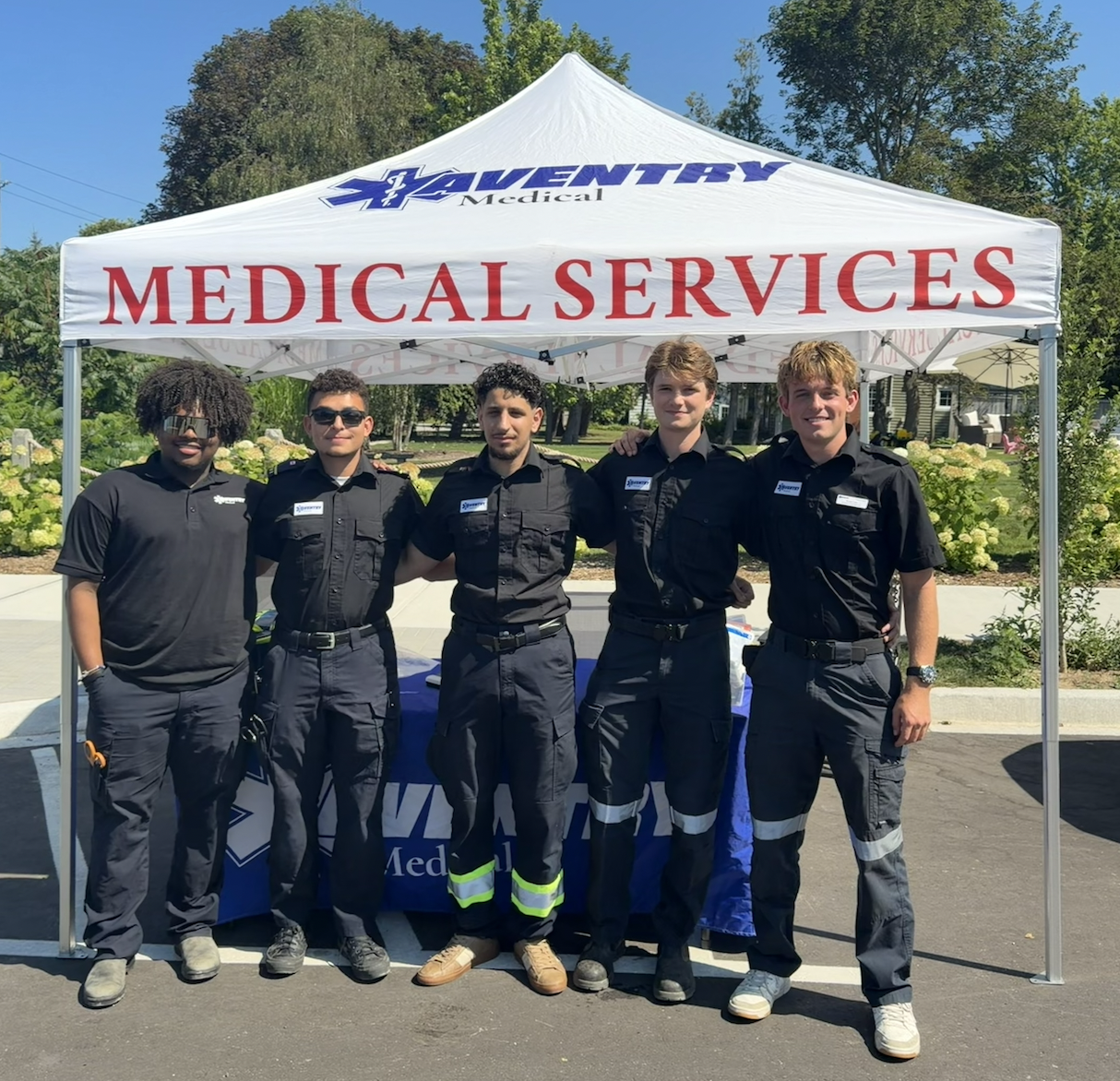
Five Aventry medics at the 2026 Gran Fondo Lake Huron in Bruce County, Ontario.
Among the various medical challenges that endurance events present, the finish line is the most predictable. Research has established, with reasonable consistency, that collapse is most likely to occur there, that certain presentations cluster there, and that the minutes immediately after an athlete stops running carry a distinct and elevated risk profile. The finish line is not where most race directors concentrate their medical resources. That gap between what the evidence shows and how events are actually planned is worth examining.
What Happens When a Runner Stops
To understand why the finish line is medically distinct, it helps to understand what the body is doing in the final stretch of a race and immediately after.
During sustained running, the leg muscles act as a secondary pump, contracting rhythmically to push blood back toward the heart from the lower extremities. When a runner crosses the finish line and stops, that muscular pump ceases. Blood pools in the legs. Cardiac output drops. In some athletes, this produces a rapid fall in blood pressure and a resulting loss of consciousness or inability to stand, a condition known as exercise-associated collapse, or EAC.
EAC is the most common presentation at endurance race finish lines, and it is also one of the most frequently mismanaged. For years, the clinical assumption was that dehydration and overheating were the primary causes of post-race collapse. A review published in the British Journal of Sports Medicine found this to be incorrect. The evidence now indicates that EAC is principally the result of transient postural hypotension from lower extremity blood pooling and the impairment of cardiac reflexes that follows cessation of exercise, not dehydration. The treatment implications are significant: a runner who collapses at the finish line and is conscious, with a normal heart rate and stable blood pressure when lying flat, almost certainly has EAC and can be managed conservatively on-site by elevating the legs and allowing the circulatory system to normalize. The same runner, if assumed to be dehydrated and given aggressive intravenous fluids, may actually be made worse if the underlying cause is hyponatraemia, a dangerous low-sodium condition that can accompany over-hydration in endurance athletes.
The finish line is not just where people collapse. It is where the cause of collapse is most easily misread.
Where Cardiac Events Actually Happen
Beyond EAC, the more serious concern at finish lines is cardiac. A ten-year prospective registry of sudden cardiac arrests during endurance racing in Paris, published in 2026 in the journal Europace, produced findings with direct implications for race medical planning.
Among more than 1.2 million participants in half-marathons and 20-kilometer races, participants were fifteen times more likely to experience sudden cardiac arrest in the final kilometer than at other points on the course. The clustering was specific to shorter races. In full marathons, cardiac arrests were distributed more evenly along the route. The researchers identified a behavioral component: 87 percent of half-marathon finishers showed some degree of acceleration in the final stretch, with male runners accelerating at nearly twice the rate of female runners. Male runners also accounted for 88 percent of all cardiac arrests in the registry.
The survival rate in this cohort was 88 percent, a figure the researchers attributed directly to the implementation of a dedicated medical system with strategically pre-positioned teams in the final kilometers and at the finish line. That survival rate is substantially higher than survival from out-of-hospital cardiac arrest in the general community, which typically runs below 12 percent. The difference is not physiology. It is preparation.
Earlier U.S. data from the Race Associated Cardiac Event Registry told a similar story. A New England Journal of Medicine study examining cardiac arrests during marathons and half-marathons in the United States between 2000 and 2010 found that cardiac arrests were significantly concentrated in the final stretch and finish-line recovery area. Of 59 runners with cardiac arrest in that cohort, 71 percent died. The Paris registry, with its concentrated medical resources in the right locations, achieved the inverse.
The Misallocation Problem
Most race medical plans are built around the course, not around the risk distribution along it. Medical stations are placed at regular intervals, often determined by logistics, volunteer availability, or tradition rather than by where presentations actually occur. The finish line medical tent is typically resourced for volume, with cots, fluids, and personnel for EAC management.
What the evidence argues for is a different model: concentrating trained personnel and AED access at and near the finish line, particularly in the final kilometer, and ensuring that anyone in that zone is capable of distinguishing EAC from the more dangerous presentations that require immediate intervention.
The clinical judgment required is not trivial. A conscious runner who collapses and recovers quickly lying down almost certainly has EAC and needs conservative management. The same runner, if confused, with a core temperature above 40 degrees Celsius, may be in exertional heat stroke. A runner who collapses and does not respond is in cardiac arrest until proven otherwise. The finish line is where all three of these can occur within minutes of each other, and where the treatment for one is contraindicated for another.
That level of triage requires personnel with specific event medicine training, not simply clinical experience in other settings.
What Planning for the Finish Line Actually Looks Like
The practical implications of the research are straightforward even if they require a deliberate shift in how resources are allocated.
Finish-line medical capability needs to be scaled to include personnel capable of managing the full range of post-race presentations, not just EAC. AEDs need to be immediately accessible in the finish chute and recovery area, not stored in a tent twenty meters away. The final kilometer of shorter races, where the cardiac arrest data clusters, warrants a roving medical presence rather than fixed stations. And the medical team needs clear protocols for differentiating EAC, exertional heat stroke, hyponatraemia, and cardiac arrest at the point of collapse, since the presenting picture can look similar across all four in the first moments.
None of this requires a dramatic increase in resources. It requires putting the right resources in the right place, which starts with understanding where the risk actually lives along a race course.
The finish line is where athletes achieve something meaningful. It is also where the evidence consistently shows the risk is highest. Planning accordingly is not an overreaction. It is the most basic form of preparation.
The Aventry Journal is published by Aventry Medical. Articles represent editorial perspectives on event safety and are intended to inform practice, not to constitute medical or legal advice.