
Why Event Medicine Is Not Emergency Medicine
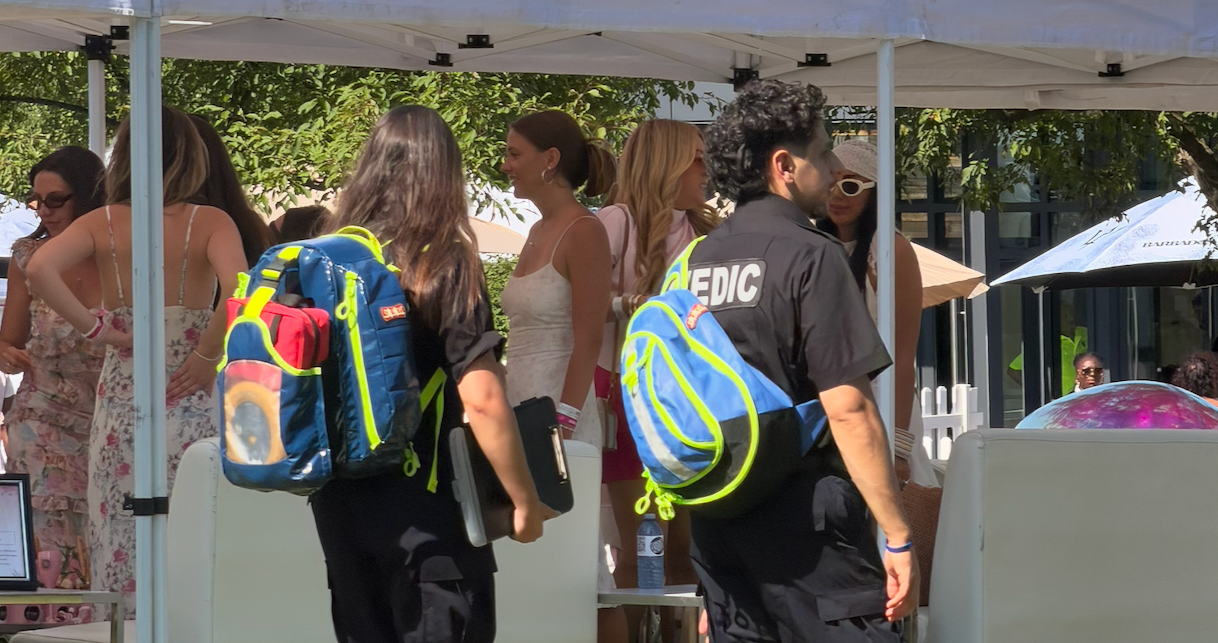
Two Aventry medics moving through an outdoor event, covering the crowd rather than waiting for the crowd to come to them.
When an event organizer hires medical coverage, the mental model is usually straightforward. A trained medical professional will be present. If something goes wrong, that person will handle it. The assumption is that medical competence is essentially portable, that someone who can manage an emergency in a hospital or an ambulance can manage one at a festival or a race.
This assumption is understandable and, in important ways, incomplete.
Mass gathering medicine is a distinct discipline. It has its own clinical logic, its own triage frameworks, its own body of research, and its own professional infrastructure, including a section within the American College of Emergency Physicians and dedicated training programs at universities across North America. The skills it requires overlap significantly with emergency medicine and paramedicine, but they are not identical. Understanding the difference matters both to medical professionals entering the field and to organizers who are making decisions about who to hire.
The Fundamental Inversion
Emergency medicine, in its standard form, is built around a patient who comes to a system. Someone calls 911. An ambulance arrives with trained personnel and equipment. The patient is transported to a controlled environment with imaging, laboratory capability, pharmacy support, and specialist backup. The clinician operates within an infrastructure designed to support complex medical decisions.
Event medicine inverts this model entirely. The clinician goes to the patient, in an environment that was designed for entertainment or athletics, not for the delivery of medical care. The infrastructure is whatever was brought and set up in advance. There is no specialist to call, no imaging available, and no pharmacy around the corner. Decisions that would normally be supported by test results have to be made on clinical judgment alone, often quickly, often in conditions that are loud, crowded, hot, and operationally complicated.
This inversion changes what good clinical practice looks like. In a hospital, a conservative approach, order the test, wait for the result, consult a colleague, is often the safest one. In an event environment, the same approach can be the wrong one. A patient in exertional heat stroke who is transported to a hospital while a clinician waits for a better assessment environment has lost the time that determines the outcome. The event setting rewards clinical decisiveness in ways that hospital practice does not always demand.
The Population Problem
One of the most significant differences between emergency medicine and event medicine is the unit of responsibility.
In a standard clinical setting, the clinician's responsibility is to the patient in front of them. In event medicine, the clinician is simultaneously responsible for a population. The decisions made about individual patients have implications for the entire event's medical capacity, for the surrounding EMS system, and for every other person in attendance who might need care in the next hour.
A paper published in Prehospital and Disaster Medicine on triage at mass gatherings identified this directly. Existing triage and acuity scoring systems, the researchers found, are suboptimal for mass gathering environments, because those systems were designed for individual patient encounters rather than for high-volume, population-level care. The event setting can involve large surges of patients, limited personnel, and the need to make rapid decisions about who gets resources and who can wait, across a population of thousands of people who are all simultaneously the clinician's responsibility.
This population-level thinking extends to the decision of whether to transport a patient at all. In emergency medicine, the default is to transport patients who need more than immediate stabilization. In event medicine, that calculus is more complex. Unnecessary transport depletes on-site resources, ties up ambulances, and sends patients to emergency departments that may not have anticipated the volume. Research has consistently shown that experienced event medical teams treat and release the majority of patients on-site, avoiding transport for cases that can be safely managed in the field. A university football stadium study found that 57.6 percent of patients who received physician evaluations were discharged without transport. That is not a lesser standard of care. It is a different standard, calibrated to the specific environment.
What the Training Recognizes
The formal recognition of event medicine as a distinct field reflects what practitioners have known for years. The British Columbia Journal of Medicine describes mass gathering medicine as a young and rapidly evolving discipline with ties to emergency medicine, disaster medicine, and public health, while noting that it encompasses operational planning, harm reduction, environmental health, and community health impact in ways that clinical emergency medicine training does not address.
The Canadian Journal of Emergency Medicine has similarly noted the complementary but distinct relationship between mass gathering medicine and other emergency disciplines. It is a relationship, not an equivalence.
This matters practically when organizers are evaluating medical coverage. A paramedic with strong clinical skills but no event medicine experience brings genuine value and genuine gaps. They may not have thought systematically about patient flow at high volume, or about how to manage a medical station that sees fifty minor presentations while staying prepared for one critical one. They may not have protocols for the treat-and-release decisions that keep events functioning without overwhelming local hospitals. These are learnable skills, but they require specific experience and training that clinical work alone does not provide.
What This Means for Organizers
None of this is an argument for credentialism over competence. A skilled paramedic with event medicine experience is a far stronger choice than a physician who has never worked outside a controlled clinical environment. What it argues against is the assumption that a credential from any clinical background automatically translates into readiness for the event environment.
The questions worth asking when evaluating medical coverage are not only about clinical certification. They are about experience in the specific setting. Has this person or team worked events of similar size and type? Do they have protocols for high-volume minor presentations alongside the capability to manage a critical one? Do they understand the relationship between on-site care and the surrounding EMS system, and how their decisions affect both?
Mass gathering medicine developed as a field because practitioners recognized that events demand something specific. Treating it as interchangeable with other forms of emergency care understates that specificity, and the people who bear the consequence of that underestimation are the ones who needed more than a general clinical background could provide.
The Aventry Journal is published by Aventry Medical. Articles represent editorial perspectives on event safety and are intended to inform practice, not to constitute medical or legal advice.