
The Hidden Cost of Undertreated Events
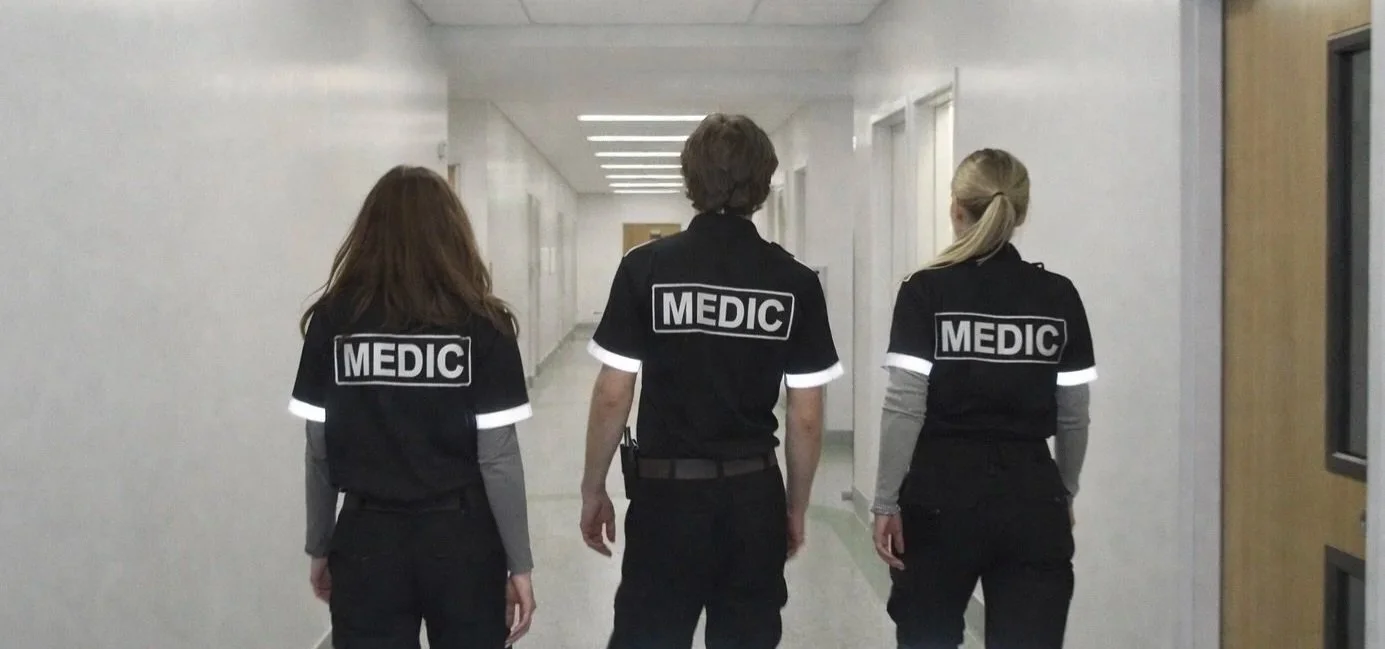
Three Aventry medics walk down a hallway in London, Ontario.
When event organizers think about the cost of medical coverage, they are usually thinking about a line item. Staff hours, equipment, logistics. These costs are visible and arrive in an invoice.
The costs of inadequate medical coverage are different. They are mostly invisible during planning, and they appear in forms that do not show up in a budget until long after the event has concluded, if they show up at all.
Understanding what those costs actually are, and who bears them, changes how the original planning decision looks.
The Patient Who Needed More
The most direct cost of inadequate event medical coverage falls on the person who needed care and did not receive it in time.
For time-critical emergencies, the difference between adequate and inadequate coverage is measured in outcomes. A cardiac arrest patient who waits twelve minutes for an AED has materially worse survival odds than one who receives defibrillation in four. A person in exertional heat stroke who is cooled immediately has a substantially higher chance of full recovery than one who is transported to a hospital fifteen minutes away. These are not marginal differences. They are the difference, in some cases, between someone going home and someone not going home.
Less visibly, there are the patients who are undertreated rather than untreated entirely. Someone whose heat exhaustion tips into heat stroke because no one recognized the early warning signs in time. Someone whose ankle fracture is managed by a well-meaning bystander in a way that causes additional damage before professional help arrives. Someone whose chest pain is attributed to anxiety and left unmonitored. These cases rarely generate headlines, but they represent real harm that adequate on-site care would have prevented.
The Strain on the Community's Healthcare System
Mass gathering events do not occur in a vacuum. When they generate medical demand that exceeds on-site capability, that demand transfers to the surrounding community, specifically to municipal EMS and local emergency departments.
Research is consistent on this point. Events with inadequate on-site medical coverage generate more ambulance calls, more emergency department visits, and more strain on systems that were already operating under load. A retrospective study of ambulance call volumes in Rhode Island found that music events and public exhibitions were significantly associated with increased EMS call rates on event days, with music events generating an average of three additional calls per 100,000 inhabitants compared to non-event days.
A comprehensive literature review focused specifically on this question found that mass gathering events impact both ambulance services and hospitals in the surrounding area. The researchers noted that events with poor planning and a lack of medical resources are particularly likely to impair baseline emergency services, meaning that people who have nothing to do with the event may find the nearest emergency services occupied or delayed because of it.
The organizer who decides not to invest in on-site medical capability is, in effect, making a decision that transfers some of that cost to a system that did not agree to absorb it, staffed by people who did not plan for it, serving patients who have nothing to do with the event.
The Organizational Aftermath
Beyond the patient and the healthcare system, there are costs that fall on the event organization itself.
An event where something goes seriously wrong due to inadequate medical preparation faces a difficult aftermath. Regulatory scrutiny, insurance implications, and civil liability are the obvious ones. Less obvious but equally significant is reputational damage that can outlast any legal proceeding.
The live events industry runs substantially on trust. Attendees, municipal partners, venues, sponsors, and volunteers all make decisions about participation based partly on their confidence that the event is run responsibly. An incident that reveals inadequate medical planning does not just affect the next year's registration numbers. It raises questions about the organization's judgment that can be difficult to answer satisfactorily.
There is also the effect on the broader event community. High-profile incidents at events have historically produced regulatory responses that affect the entire industry, not just the organizer responsible. The Texas Task Force on Concert Safety, convened following the Astroworld incident in 2021, produced a detailed set of recommendations that now influence event planning standards across North America. Inadequate medical planning at any event of meaningful scale is not purely a private risk. It contributes to conditions that shape how events are regulated for everyone.
What Adequate Coverage Actually Costs
The full picture requires acknowledging that on-site medical coverage does have a real cost, and that for smaller events, that cost is not trivial. The argument here is not that all events can afford unlimited medical resources or that organizers are reckless if they work within a budget.
The argument is that the cost comparison should be honest. The visible cost is the invoice for medical staffing and equipment. The invisible costs include the patient outcomes that adequate coverage would have changed, the EMS and hospital burden that on-site care would have absorbed, the organizational and reputational exposure that an incident creates, and the broader effect on the industry's relationship with regulators and the public.
When those costs are in the same frame, the calculation looks different than it does when the only number visible is the one on the invoice.
The Aventry Journal is published by Aventry Medical. Articles represent editorial perspectives on event safety and are intended to inform practice, not to constitute medical or legal advice.