
Do I Need Medical Services for My Event?
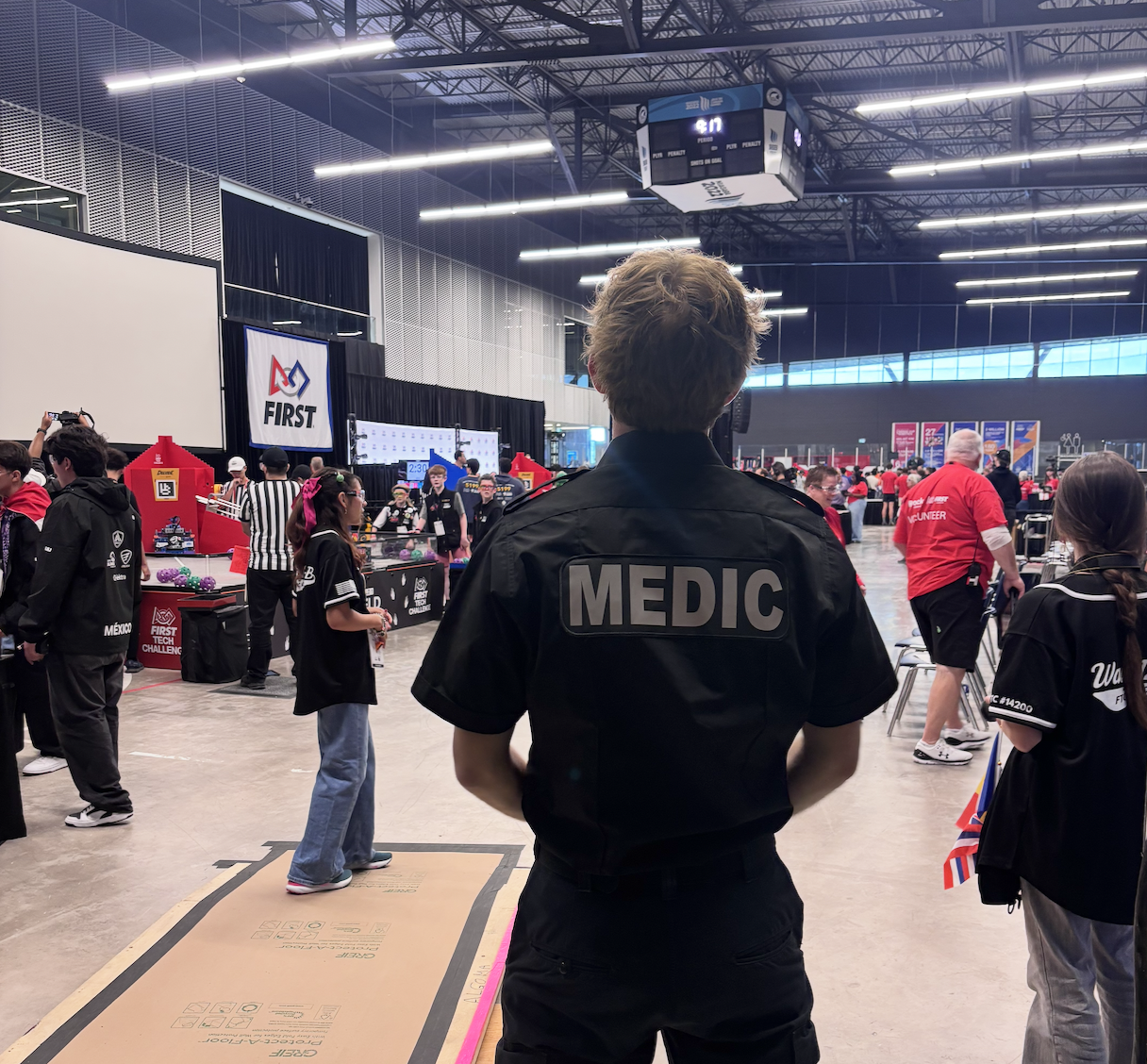
An Aventry medic waits on standby at the Canada Cup of Robotics in June 2026.
Every event organizer eventually faces the question, usually while reviewing a budget or negotiating with a venue. Do we actually need medical coverage? Is it required? And if it is not required, is it still necessary?
The answer is that the question itself tends to be framed too narrowly. The more useful question is not whether medical coverage is required, but what level of coverage is appropriate given everything that could realistically go wrong, and what the consequences of getting that wrong might be.
This article is intended to help organizers think through that question with the same rigor they would apply to any other operational decision.
The Assumption That 911 Is Enough
The most common reason organizers forgo formal medical coverage is a belief that municipal emergency services are sufficient. If something happens, someone will call 911, and help will arrive.
This assumption has a specific, measurable problem: time.
For cardiac arrest, one of the most time-critical emergencies that can occur at a public event, survival probability drops by roughly seven to ten percent for every minute that passes without defibrillation. The average EMS response time in many North American communities runs between six and twelve minutes. In dense event environments where vehicle access is limited and crowds slow movement on foot, that window stretches further. By the time paramedics reach a patient who has collapsed near the center of a busy venue, the outcome may already be determined.
Data from the 2024 CARES Annual Report makes the stakes concrete. CARES is the Cardiac Arrest Registry to Enhance Survival, a CDC-affiliated national surveillance database that covers approximately 56 percent of the U.S. population. Among out-of-hospital cardiac arrests occurring in public locations, only about 12.6 percent of patients actually had an AED applied by a bystander before EMS arrived. When a bystander did apply an AED in a public setting, survival to hospital discharge reached 33.6 percent, more than three times the overall national average of 10.5 percent. The intervention changes outcomes decisively. The question for any event organizer is whether anyone on-site is trained and positioned to deliver it within the window that matters.
The 911-is-enough model depends on a chain of assumptions: that a bystander will recognize the emergency quickly, that they will call immediately, that dispatchers will route correctly, that EMS will arrive without delay, and that access to the patient will be unobstructed. Each assumption is plausible on its own. Together, they represent a considerable margin of uncertainty at precisely the moment when seconds determine whether someone survives.
Depending on that chain, without any redundancy built into the event's own medical plan, is not a neutral decision. It is a bet on circumstances behaving perfectly.
What the Evidence Says About Medical Demand at Events
Research into mass gathering medicine has produced a reasonably consistent picture of how medical needs present at public events, and North American data is instructive here.
A five-year retrospective study of the New York State Fair, published in Prehospital and Disaster Medicine, analyzed patient presentations across approximately 4.75 million attendees between 2004 and 2008. The three leading reasons for seeking care were dehydration and heat-related illness, abrasion and laceration, and fall-related injury. These are not catastrophic emergencies. They are the ordinary consequences of large numbers of people spending extended time on their feet outdoors, and they represent the baseline demand that any event medical plan needs to be built to absorb.
A broader scoping review published in 2024, drawing on 22 studies including seven from the United States, found that patient presentation rates at stadium and arena events ranged from one to 24 per 10,000 spectators, with a median of 3.8 per 10,000. Hospital transport rates were considerably lower, with a median of 0.35 per 10,000, reflecting the fact that most medical encounters at events are minor and resolvable on-site.
That distinction matters more than it might appear. When the research consistently shows that 87 percent or more of event medical presentations are minor in nature, it is tempting to conclude that the overall risk is low. The more accurate conclusion is that well-resourced on-site care, capable of triaging and treating minor presentations efficiently, is what allows the small fraction of serious cases to receive immediate attention rather than competing with routine cases for a delayed external response.
Research on the role of on-site physicians reinforces this. A study examining physician integration at a large U.S. air show, published in Prehospital and Disaster Medicine, found that on-site emergency physicians reduced burden on surrounding EMS systems while improving real-time care. A literature review by the National Association of EMS Physicians concluded that on-site medical care, physician oversight, and structured incident command substantially reduce unnecessary hospital transports and preserve community healthcare capacity. A university football stadium study found that 57.6 percent of patients who received full physician evaluations were discharged on-site, never requiring transport at all. Each of those non-transports represents a patient who received timely care, an ambulance crew that remained available for other calls, and an emergency department that absorbed one fewer unplanned arrival.
The Factors That Actually Determine Risk
Medical need at events is not primarily a function of crowd size, though size matters. Research consistently identifies a cluster of interacting factors that drive patient presentation rates and, more importantly, severity.
Crowd density and venue layout. Larger crowds increase the probability that someone will need help. But the more operationally significant variable is access. A crowd of five thousand people in an open field is medically easier to manage than three thousand in a tightly configured indoor venue where stretcher movement is difficult and sightlines are limited. The time it takes trained personnel to reach a patient, not the number of people present, is often what determines whether a manageable situation becomes a critical one.
Event type and participant activity level. A seated classical music performance and an endurance road race involve very different physiological demands. Participants in physically demanding events, running races, cycling competitions, obstacle courses, are at elevated risk of exertional heat illness, cardiac events, and musculoskeletal injury. Spectator events carry their own risks, particularly among attendees who are older, consuming alcohol, or standing for extended periods in direct sun. The event type shapes what is likely to go wrong, and medical planning should reflect that specificity.
Weather and environment. Temperature and humidity are among the most reliably documented predictors of medical demand at outdoor events. Research has found that increased patient presentation rates are strongly associated with higher heat index values. This is particularly relevant across much of Canada and the northern United States, where summer heat combined with humidity, as in southern Ontario, the St. Lawrence corridor, or the Great Plains, can push apparent temperatures well above ambient readings. An event that presents modest medical risk in May can present substantially higher risk on a humid August afternoon.
Alcohol availability. The relationship between alcohol consumption and medical demand at events is well-documented. Alcohol impairs thermoregulation, elevates injury risk, and masks the early symptoms of both heat illness and cardiac events. Its effects compound in warm weather. Events where alcohol is served for extended hours, particularly outdoor festivals, consistently see higher patient presentation rates than comparable events without it. This is not an argument against alcohol service. It is an argument for calibrating medical coverage accordingly.
Audience demographics. An older audience at a stadium concert presents different medical considerations than a younger crowd at an outdoor music festival. Older attendees carry higher rates of underlying cardiovascular and respiratory conditions. Younger crowds may present more exertional illness, drug-related emergencies, and behavioral crises. Neither profile is inherently more dangerous. They are differently dangerous, and effective medical planning accounts for the specific population expected, not a generic average.
Distance from definitive care. An event held two blocks from a trauma center is medically different from one held at a rural fairground sixty minutes from the nearest emergency department. In remote or semi-remote settings, the event's medical team is not supplementing the healthcare system. For the duration of that event, it effectively is the healthcare system. That changes what equipment is needed, what scope of care must be deliverable on-site, and how the event should be staffed.
Thinking About Levels, Not Binaries
The question "do I need medical coverage?" tends to produce a yes-or-no frame. The more productive frame is a spectrum, with coverage calibrated to actual risk rather than to minimum thresholds or to what happens to be affordable in a given budget cycle.
At the minimal end, small events in accessible urban locations, with mild weather, no alcohol service, and low physical demand on participants, may be adequately served by a trained first aider with a clear protocol for activating 911. There is no universal crowd size that makes this insufficient. Context is what determines it.
As events grow in size, duration, environmental complexity, or activity risk, coverage needs to scale in kind. That scaling should be driven by an honest assessment of the factors described above, not by round numbers or assumptions about what similar events have done.
The right medical plan accounts for the worst plausible scenario, not the most likely one. The most likely scenario at any event is that nothing serious happens. A plan designed only for that outcome is not really a plan.
The Case That Gets Made After the Fact
There is a recognizable pattern in how event medical failures are analyzed after they occur. Investigators and journalists trace back through the decisions that led to inadequate coverage: the budget pressure that caused someone to cut the medical line, the proximity of a hospital that was assumed to make on-site care redundant, the belief that the event was low-risk because attendance was modest or the audience was young and healthy. These decisions are often entirely understandable given the information available at the time. They look very different once something has gone wrong.
The decision about medical coverage is, at its core, a risk decision. Like any risk decision, it involves weighing the cost of preparation against the probability and consequences of something going wrong. The costs of adequate coverage are visible, concrete, and show up in a budget. The costs of inadequate coverage are invisible right up until they are not.
What makes event medicine distinct from other operational risks is the breadth of who bears the consequences. When medical coverage falls short, the cost is not only absorbed by the event organization. It falls on the patient who did not receive timely care, on their family, on the local emergency department that receives a transfer that could have been managed on-site, and on the broader community's confidence that public gatherings are safe to attend.
That is a wider frame than most budget conversations contemplate. It is also the accurate one.
A Starting Framework
For organizers working through this decision, a structured set of questions produces a more reliable picture than either instinct or a simple crowd count.
What is the realistic worst-case medical scenario at this event, and how quickly could a trained response be mounted? Is every part of the venue accessible to stretchers and response vehicles? What are the temperature and humidity forecasts, and do they materially change the risk? What is the expected audience demographic, and are there specific medical vulnerabilities associated with that population? Is alcohol being served, and for how long? What is the distance to the nearest emergency department with the right capabilities? And what do local permit requirements and insurance conditions actually specify?
These questions do not produce a single answer. They produce a risk picture, and that picture should drive the coverage decision, not the nearest round number in a budget spreadsheet.
Medical coverage at events is not a regulatory checkbox. It is an operational commitment to the people who have trusted you enough to show up.
The Aventry Journal is published by Aventry Medical. Articles represent editorial perspectives on event safety and are intended to inform practice, not to constitute medical or legal advice.