
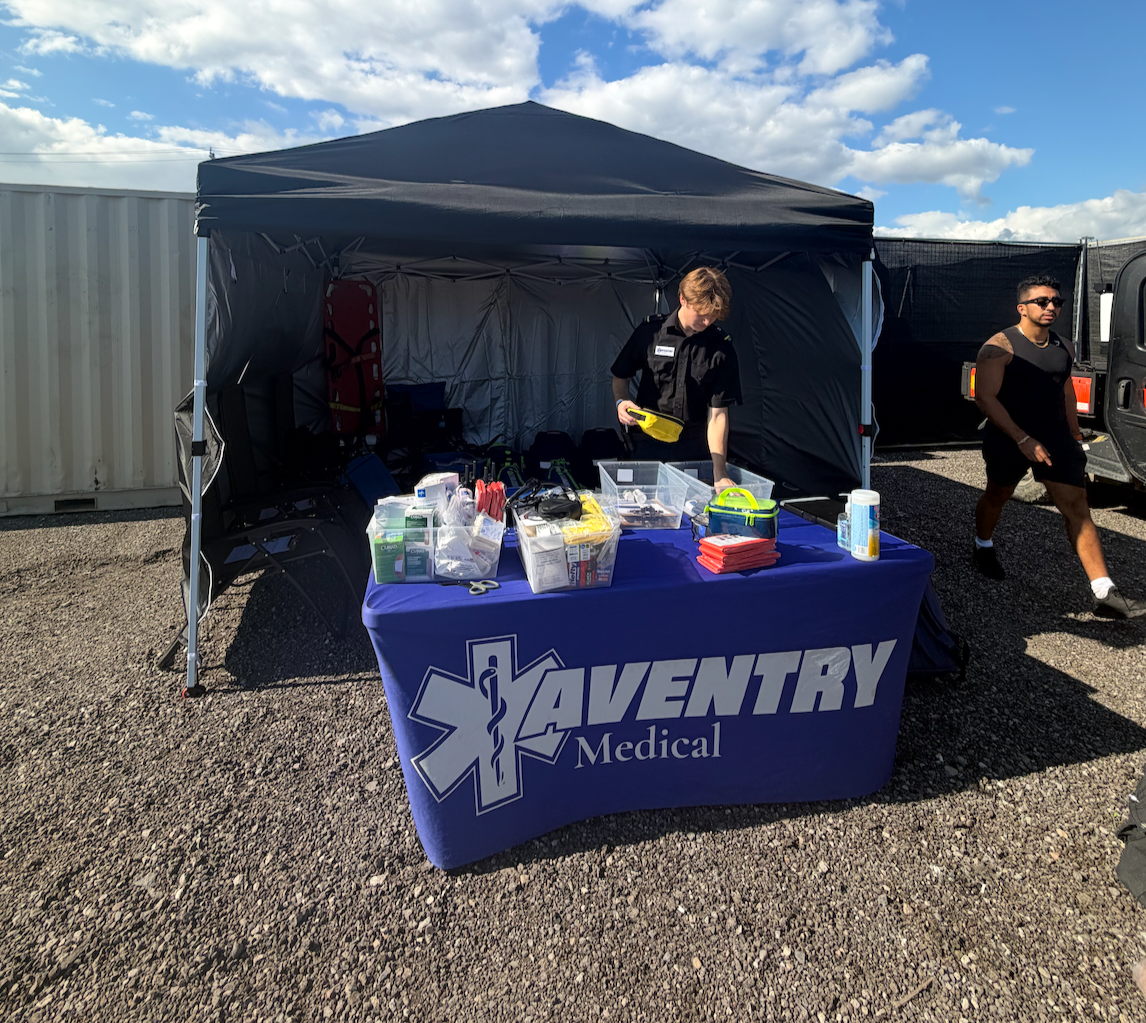
For most of the past decade, two conversations about drugs have run in parallel in Canada. The first concerns the toxic drug crisis, discussed in terms of street-level use, supervised consumption, and public health emergency declarations. The second concerns drug use at festivals, which has long been treated as a separate and milder matter: the occasional heat illness, the overwhelmed first-timer, a medical tent that mostly sees sunburn, blisters, and dehydration.
Event organizers have generally planned as though these two worlds did not touch. The evidence suggests they meet at the point of supply, and that the medical tent is where the meeting becomes visible.
One Supply, Many Buyers
The scale of the national crisis is easy to lose in familiarity. Between January 2016 and June 2025, Canada recorded 53,308 apparent opioid toxicity deaths. In the first half of 2025, 83 percent of those deaths involved non-pharmaceutical opioids, and 68 percent also involved a stimulant.
That last figure deserves attention from anyone who plans event medicine. Stimulants are what many festival attendees expect to be taking. Opioids are not. The national data show the two appearing together in most opioid deaths, which means the supply chains that deliver one are rarely separate from the supply chains that deliver the other.
The national trend is also moving in a better direction, and an honest account has to say so. The Council of Chief Medical Officers of Health reported 5,608 opioid-related deaths in 2025, an average of 15 per day and a decline of 23 percent from 2024. Stimulant-related deaths fell by 31 percent. In reporting on the earlier 2024 decline, provincial and territorial public health partners noted that drug checking data pointed to a less toxic supply, at least in part. The same federal statement describes deaths as still higher than before the pandemic, and notes that several jurisdictions, Ontario among them, now report more stimulant-related deaths than opioid-related ones.
An improving average is good news for the country. It tells an event medical team very little, because event medicine does not plan for the average supply. It plans for the worst plausible night.
What Drug Checking at Festivals Found
Canada has an unusually good evidence base on what festival drugs actually contain, because drug checking in this country began in festival culture. Harm reduction teams in British Columbia have offered point-of-care testing at events for years.
A study from the BC Centre on Substance Use, published in Drug and Alcohol Dependence in 2019, analyzed checking services at four BC festivals in the summer of 2018. Of 66 samples that clients expected to be stimulants, 62.1 percent contained only the expected substance, while 36.4 percent contained additional contaminants. Among 233 samples expected to be psychedelics, 72.5 percent were as expected and 11.6 percent contained added contaminants. The unexpected additives included levamisole, phenacetin, novel psychoactive substances, and in a small number of cases fentanyl.
An earlier report from the Shambhala festival, published in the Canadian Journal of Public Health, tested 1,971 samples for fentanyl in 2017 and found 31 positive, about 1.6 percent.
These are not numbers that support alarm. Fentanyl appeared in a small minority of festival samples. They are also not numbers that support complacency, for a reason familiar to anyone who plans for low-probability, high-consequence events. A contamination rate under two percent is low. It is not zero, and the person holding the sample has no way of knowing which side of that line they are on. The BC government reported that in 2018, 19 percent of the province's overdose deaths involved people who used drugs infrequently or recreationally. The festival attendee who uses drugs a few times a year is also the person least likely to carry any tolerance to an opioid they never intended to take.
The Shambhala data contain one more finding worth noting. When clients learned their sample was positive for fentanyl, roughly 16 percent discarded it, compared with under 3 percent of those whose samples were negative. People, given reliable information, change what they do. They cannot do so without it.
What Changes in the Medical Tent
A medical team that treats festival intoxication as a single, familiar category is working with an incomplete picture. Stimulant toxicity tends to present with agitation, racing heart rate, and rising body temperature. Opioid toxicity presents with sedation and slowed breathing. A patient who has taken an unknown mixture may show one pattern, the other, or a confusing combination, and may be unable to say what they took because they do not know.
The picture is complicated further by newer opioids. Nitazenes, a class of synthetic opioids first identified in Canada's unregulated supply in 2019, account for a small share of Canadian opioid deaths. Public Health Agency of Canada surveillance shows fewer than one percent of apparent opioid toxicity deaths involving them, 15 deaths in 2024 after a peak of 55 in 2021. Their relevance to event medicine is clinical rather than statistical. The Agency notes that nitazene poisonings can be harder to reverse and may require multiple doses of naloxone. A tent stocked with a single kit has planned for a different problem than the one it may meet.
Drug-related presentations are also not confined to one kind of event. A retrospective study of a Dutch festival medical provider, published in Prehospital Emergency Care in 2025, examined patients needing advanced medical care. Drug-related causes accounted for 74 percent of those cases at electronic dance music festivals and 52 percent at mainstream festivals. The study is European and its findings should be applied to Canadian events with care, but the second figure is the more instructive one. At events not usually associated with drug use, a majority of the most serious cases were still drug-related.
Canadian research points the same way. A study by Lund and Turris of a two-day electronic dance music event in British Columbia found that such events produce predictable risks and patient presentations, and that appropriate on-site health resources can substantially reduce the burden on the surrounding emergency system. The key word is predictable. This is a known category of demand, not a surprise.
Why a First Aid Model Falls Short
Much of the event medical coverage in this country is built around a first aid model, designed for sprains, cuts, and heat exhaustion. That model has real value, and it is not the right tool for a patient whose breathing is slowing or whose core temperature is climbing past 40 degrees Celsius.
What these presentations demand is clinical capability. That means airway and ventilation support, the ability to give naloxone and repeat it, temperature measurement and active cooling for stimulant-related hyperthermia, and the judgment to monitor a patient over time. A patient who responds to naloxone is not necessarily out of danger, because the reversal agent can wear off before the opioid does, and sedation can return. Deciding who stays on-site under observation and who needs transport is exactly the treat-or-transfer judgment that distinguishes event medicine from first aid, and that protects the surrounding hospitals from avoidable load.
There is also a cultural dimension. It is reasonable to infer, though the evidence here is observational, that attendees who fear legal consequences or judgment will seek help later, or not at all, and that a medical tent perceived as punitive will see its sickest patients last. A team that treats a drug-related presentation as a clinical problem and not a moral one gets earlier access to patients, which in an overdose is the variable that matters most.
What Organizers Can Do
None of this requires an organizer to take a position on drug policy. It requires them to ask better questions of their medical plan.
Does the medical team carry naloxone in quantity, and are its members trained and authorized to give repeated doses? Can it manage a hyperthermic, agitated patient and a sedated, slow-breathing one at the same time? Is there a space where patients can be observed after treatment, not simply discharged or loaded into an ambulance? Is there a working relationship with local public health, so that drug alerts reach the medical team before the gates open? Is the transport plan realistic if two or three serious patients arrive within the same hour?
Whether an event hosts drug checking involves legal, licensing, and community questions that vary by province and should be worked through with local public health authorities and counsel. The medical argument for readiness does not depend on that decision. The tent should be ready either way.
Planning for the Variance
The supply may be less toxic this season than it was last year. It may not be. Drug markets move faster than surveillance, and surveillance moves faster than permit applications. An event that planned its medical coverage on last year's national average has planned for something that will not be in the crowd.
A festival gate is a place where thousands of people from every community converge, each carrying whatever they were sold. The medical tent is the one place on the grounds where that variability becomes visible, one patient at a time. It should be built to see it.
The Aventry Journal is published by Aventry Medical. Articles represent editorial perspectives on event safety and are intended to inform professional practice, not to constitute medical or legal advice.